

Who never found themselves in the line at the supermarket and, at the time of payment, realised that their wallet had been left at home or in the car? Today, this is a problem of the past, as the matter can be solved in seconds through your smartphone or smartwatch with just a few clicks.
New payment methods and interfaces emerged as time passed, and the evolution of different technologies and consequent digital transformation has propelled these changes in the payment process. Today, electronic payments are often the first choice of consumers, who adopt solutions such as MB WAY, Apple Pay or Google Pay.
One of the main advantages of these systems is their efficiency and speed since, unlike traditional methods, they eliminate potential errors and delays. In addition, these new operations also contribute to a considerable cost-benefit ratio, where, for example, companies that carry out large transfers, whether national or international, can benefit from lower transaction fees and a reduction in operating costs. Incidentally, when it comes to transactions abroad, we should note that worldwide accessibility is another crucial benefit of digital payments. With these tools, consumers can send money to family members more easily across borders, while companies can enter new markets and expand their customer base.
Furthermore, still addressing the business context, this method allows organisations to make more informed strategic decisions, as the use of digital payments facilitates the gathering and analysis of data, promoting better decision-making.
However, it is inevitable to discuss the security issue regarding digital payments. Even though exposure to the online world brings with it the risk of cyber-attacks, through encryption technologies, authentication processes and fraud detection tools, it is possible to guarantee the integrity of the transaction, thus increasing consumer trust.
I believe this issue is also closely linked to the resistance to change. In other words, not all generations are comfortable migrating to digital, especially the older ones. On the one hand, there is the issue of familiarity with ‘’traditional‘’ methods such as cash and physical cards. On the other hand, the rapid technological evolution and a lack of understanding due to the scarcity of digital education become intimidating, and concerns about security or the absence of ‘’physical‘’ technical support intensify this reluctance.
Another challenge for the adoption of digital payment systems is, sometimes, the lack of suitable infrastructure, and organisations may face more difficulties in using these solutions in regions with poor connectivity.
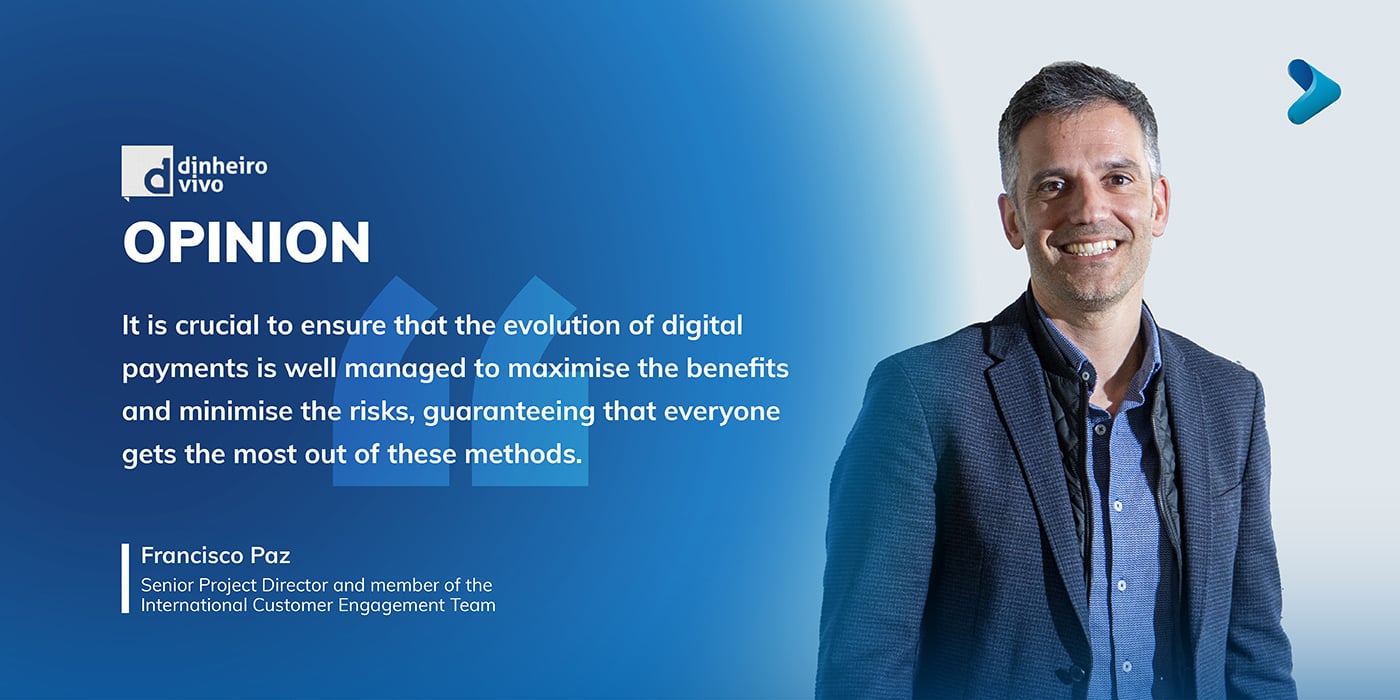
It is crucial to ensure that the evolution of digital payments is well managed to maximise the benefits and minimise the risks, guaranteeing that everyone gets the most out of these methods. As these systems become an integral part of our future, it is up to businesses, consumers and regulators to ensure that we navigate this new era safely, efficiently and innovatively.
News: Dinheiro Vivo

Terms & Conditions